NOW!
THE THEOSOPHY WALES WEBSITE
THAT JUST WON’T WAIT

Bangor, Cardiff,
Conwy & Swansea

Swans at Llyn Padarn,
Snowdonia,
Theosophy Wales
has no controlling body
and is made up of
independent groups

Sunset over Gospel Pass in the black
Mountains
in South East Wales near the border with
Herefordshire, England.
_________________

The Seven Principles of Man
By
Annie Besant
Principle V.
Manas, The Thinker,
or Mind
We have reached the most complicated part of our study, and some thought
and attention are necessary from the reader to gain even an elementary idea of
the relation held by the fifth principle to the other principles in man.
The word Manas comes from the Sanskrit word – man, the root of the verb
to think ; it is the Thinker in us, spoken of vaguely in the West as mind. I
will ask the reader to regard Manas as Thinker rather than as mind, because the
word Thinker suggests some one who thinks, i.e., an individual, an entity. And
this is
exactly the Theosophical idea of Manas, for Manas is the immortal
individual, the real " I ," that clothes itself over and over again
in transient personalities, and itself endures for ever.
It is described in the Voice of the Silence in the exhortation addressed
to the candidate for initiation: "Have perseverance as one who doth for
evermore endure. Thy shadows [personalities] live and vanish ; that which in
thee shall live for ever, that which in thee knows, for it is knowledge, is not
of fleeting life; it is the man that was, that is, and will be, for whom the
hour shall never strike" (p. 31). H.P.Blavatsky has described it very
clearly in the Key to Theosophy: "Try to imagine a ‘Spirit,’ a celestial
being, whether we call it by one name or another, divine in its essential
nature, yet not pure enough to be one with the ALL, and having, in order to
achieve this, to so purify its nature as finally to gain that goal.
It can do so only be passing individually and personally, i.e.,
spiritually and physically, through every experience and feeling that exists in
the manifold or differentiated universe. It has, therefore, after having gained
such experience in the lower kingdoms, and having ascended higher and still
higher with every rung on the ladder of being, to pass through every experience
on the human planes.
In its very essence it is Thought, and is, therefore, called in its
plurality Manasaputra, ‘the Sons of (universal) Mind.’ This individualised
‘Thought’ is what we Theosophists call the real human Ego, the thinking entity
imprisoned in a case of flesh and bones. This is surely a spiritual entity, not
matter (that is, not matter as we know it, on the plane of the objective
universe) – and such entities are the incarnating Egos that inform the bundle
of animal matter called mankind, and whose names are Manasa or minds" (Key
to Theosophy, p. 183-184).
This idea may be rendered yet clearer perhaps by a hurried glance cast
backward over man’s evolution in the past. When the quaternary had been slowly
built up, it was a fair house without a tenant, and stood empty awaiting the
coming of the one who was to dwell therein.
The name Mânasaputra (the sons of mind) covers many grades of
intelligence, ranging from the mighty "Sons of the Flame" whose human
evolution lies far behind them, down to those entities who gained
individualisation in the cycle preceding our own, and were ready to incarnate
on this earth in order to accomplish their human stage of evolution.
Some superhuman intelligences incarnated as guides and teachers of our
infant humanity, and became founders and divine rulers of the ancient
civilisations.
Large numbers of the entities spoken of above, who had already evolved
some mental faculties, took up their abode in the human quaternary, in the
mindless men. These are the reincarnating Mânasaputra, who became the tenants
of the human frames as then evolved on earth, and these same Mânasaputra,
reincarnating age after age, are the Reincarnating Egos, the Manas in us, the
persistent individual, the fifth principle in man.
The remainder of mankind through successive ages received from the
loftier Mânasaputra their first spark of mind, a ray which stimulated into
growth the germ of mind latent within them, the human soul thus having its
birth in time there. It is these differences of age, as we may call them, in
the beginning of the individual life, of the specialisation of the eternal
Divine Spirit into a human soul, which explain the enormous differences in
mental capacity found in our present humanity.
The multiplicity of names given to this fifth principle has probably
tended to increase the confusion surrounding it in the minds of many who are
beginning to study Theosophy.
Mânasaputra is what we call the historical name, the name that suggests
the entrance into humanity of a class of already individualised souls at a
certain point of evolution ; Manas is the ordinary name, descriptive of the
intellectual nature of the principle ; the Individual or the " I ,"
or Ego, recalls the fact that this principle is permanent, does not die, is the
individualising principle, separating itself in thought from all that is not
itself, the Subject in Western terminology as opposed to the Object ; the Higher
Ego puts it into contrast with the Personal Ego, of which something is to be
presently said.
The Reincarnating Ego lays stress on the fact that it is the principle
that reincarnates continually, and so unites in its own experience all the
lives passed through on earth. There are various other names, but they will not
be met with in elementary treatises.
The above are those most often encountered, and there is no real
difficulty about them, but when they are used interchangeably, without
explanation, the unhappy student is apt to tear his hair in anguish, wondering
how many principles he has got hold of, and what relation they bear to each
other.
We must now consider Manas during a single incarnation, which will serve
as the type of all, and we will start when the Ego has been drawn – by causes
set a-going in previous earth-lives – the family in which is to be born the
human being who is to serve as its next tabernacle. (I do not deal here with
reincarnation, since that great and most essential doctrine of Theosophy must
be expounded separately).
The Thinker, then, awaits the building of the "house of life"
which he is to occupy ; and now arises a difficulty ; himself a spiritual
entity living on the mental or third plane upwards, a plane far higher than
that of the universe, he cannot influence the molecules of gross matter of
which his dwelling is built by the direct play upon them of his own most subtle
particles.
So, he projects part of his own substance, which clothes itself with
astral matter, and then with the help of etheric matter permeates the whole
nervous system of the yet unborn child, to form, as the physical apparatus
matures, the thinking principle in man. This projection from Manas, spoken of
as its reflection, its shadow, its ray, and by many another descriptive and
allegorical name, is the lower Manas, in contradistinction to the higher Manas
– Manas, during every period of incarnation, being dual.
On this, H.P.Blavatsky says: "Once imprisoned, or incarnate, their
(the Manas) essence becomes dual; that is to say the rays of the eternal divine
Mind, considered as individual entities, assume a twofold attribute which is
(a) their essential, inherent, characteristic, heaven-aspiring mind
(higher Manas), and
(b) the human quality of thinking, or animal cogitation, rationalised
owing to the superiority of the human brain, the Kâma-tending or lower
Manas" (Key to Theosophy, p. 184).
We must now turn our attention to this lower Manas alone, and see the
part which it plays in the human constitution.
It is engulfed in the quaternary, and we may regard it as clasping Kâma
with one hand, while with the other it retains its hold on its father, the
higher Manas.
Whether it will be dragged down by Kâma altogether and be torn away from
the triad to which by its nature it belongs, or whether it will triumphantly
carry back to its source the purified experiences of its earth-life – that is
the life-problem set and solved in each successive incarnation.
During earth-life, Kâma and the lower Manas are joined together, and are
often spoken of conveniently as Kâma-Manas. Kâma supplies, as we have seen, the
animal and passional elements ; the lower Manas rationalises these, and adds
the intellectual faculties ; and so we have the brain-mind, the
brain-intelligence, i.e.., Kâma-Manas functioning in the brain and nervous
system, using the physical apparatus as its organ on the material plane.
In man these two principles are interwoven during life, and rarely act
separately, but the student must realise that "Kâma-Manas " is not a
new principle, but the interweaving of the fourth with the lower part of the
fifth.
As with a flame we may light a wick, and the colour of the flame of the
burning wick will depend on the nature of the wick and of the liquid in which
it is soaked, so in each human being the flame of Manas set alight the brain
and Kâmic wick, and the colour of the light from that wick will depend on the
Kâmic nature and the development of the brain-apparatus.
If the Kâmic nature be strong and undisciplined it will soil the pure
manasic light, lending it a lurid tinge and fouling it with noisome smoke. If
the brain-apparatus be imperfect or undeveloped, it will dull the light and
prevent it from shining forth to the outer world.
As was clearly stated by H.P.Blavatsky in her article on
"Genius" ; "What we call ‘the manifestations of genius’ in a
person are only the more or less successful efforts of that Ego to assert
itself on the outward plane of its objective form – the man of clay – in the
matter-of-fact daily life of the latter.
The Egos of a Newton, an Æschylus, or a Shakespeare are of the same
essence and substance as the Egos of a yokel, an ignoramus, a fool, or even an
idiot ; and the self-assertion of their informing genii depends on the
physiological and
material construction of the physical man. No Ego differs from another
Ego in its primordial or original essence and nature.
That which makes one mortal a great man and of another a vulgar silly
person is, as said, the quality and make-up of the physical shell or casing,
and the adequacy or inadequacy of brain and body to transmit and give
expression to the light of the real inner man ; and this aptness or inaptness
is, in its turn, the result of Karma.
Or, to use another simile, physical man is the musical instrument, and
the Ego the performing artist. The potentiality of perfect melody of sound is
in the former – the instrument – and no skill of the latter can awaken a
faultless harmony out of a broken or badly made instrument.
This harmony depends on the fidelity of transmission, by word and act,
to the objective plane, of the unspoken divine thought in the very depths of
man’s subjective or inner nature. Physical man may – to follow our simile – be
a priceless Stradivarius, or a cheap and cracked fiddle, or again a mediocrity
between the two, in the hands of the Paganini who ensouls him" (Lucifer
November, 1889, p.228).
Bearing in mind these limitations and idiosyncrasies ([Limitations and
idiosyncrasies due to the action of the Ego in previous earth-lives, be it
remembered ] imposed on the manifestations of the thinking principle by the
organ through which it has to function, we shall have little difficulty in
following the workings of the lower Manas in man ; mental ability, intellectual
strength, acuteness, subtlety – all these are its manifestations ; these may
reach as far as what is often called genius, what H.P. Blavatsky speaks of as
"artificial genius, the outcome of culture and of purely intellectual
acuteness." Its nature is often demonstrated by the presence of Kâmic
elements in it, of passion, vanity and arrogance.
The higher Manas can but rarely manifest itself at the present stage of
human evolution. Occasionally a flash from those loftier regions lightens the
twilight in which we dwell, and such flashes alone are what the Theosophist
calls true genius ; "Behold in every manifestation of genius, when combined
with virtue, the undeniable presence of the celestial exile, the divine Ego
whose jailer thou art, O man of matter."
For theosophy teaches "that the presence in man of various creative
powers" – called genius in their collectivity – is due to no blind chance,
to no innate qualities through hereditary tendencies – though that which is
known as atavism may often intensify these faculties – but to an accumulation
of individual antecedent experiences of the Ego in its preceding life and
lives.
For, omniscient in its essence and nature, it still requires experience,
through its personalities, of the things of earth, earthly on the objective
plane, in order to apply the fruition of that abstract experience to them. And,
adds our philosophy, the cultivation of certain aptitudes through out a long
series of past incarnations must finally culminate, in some one life, in a
blooming forth as genius, in one or another direction" – ( Lucifer
November, 1889, p. 229-30). For the manifestation of true genius, purity of
life is an essential condition.
Kâma-Manas is the personal self of man ; we have already seen that the
quaternary, as a whole, is the personality, "the shadow," and the
lower Manas gives the individualising touch that makes the personality recognise
itself as " I ". It becomes intellectual, it recognises itself as
separate from all other selves ; deluded by the separateness it feels, it does
not realise a unity beyond all that it is able to sense.
And the lower Manas, attracted by the vividness of the material-life
impressions, swayed by the rush of the Kâmic emotions, passions and desires,
attracted to all material things blinded and deafened by the storm voices among
which it is plunged – the lower Manas is apt to forget the pure and serene glory
of its birthplace, and to throw itself into the turbulence which gives rapture
in lieu of peace.
And, be it remembered, it is this very lower Manas that yields the last
touch of delight to the senses and to the animal nature ; for what is passion
that can neither anticipate nor remember, where is ecstasy without the subtle
force of imagination, the delicate colours of fancy and of dream?
But there may be chains yet more strong and constraining, binding the
lower Manas fast to the earth. They are forged of ambition, of desire for fame,
be it for that of the statesman’s power, or of supreme intellectual
achievement. So long as any work is wrought for sake of love, or praise, or
even recognition that the work is "mine" and not another’s ; so long
as in the heart’s remotest chambers one subtlest yearning remains to be
recognised as separate from all ; so long, however grand the ambition, however
far reaching the charity, however lofty the achievement, Manas is tainted with
Kâma, and is not pure as its source.
____________________________

Annie Besant with Mahatma Gandhi
___________________________

_____________________________
Find
out more about
with
these links
Cardiff
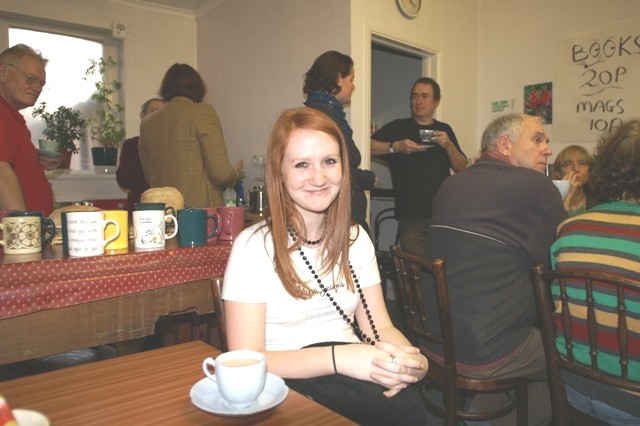
Theosophical Society meetings are informal
and there’s always
a cup of tea afterwards
The Cardiff Theosophical Society Website

Newtown,
Powys, Mid
The National
Wales Theosophy Website
Bangor, Cardiff, Conwy & Swansea

The Hayes
Cardiff City Centre
If you run a Theosophy Group, please feel free
to use any of the material on this site
The Most Basic Theosophy
Website in the Universe
A quick overview of Theosophy
and the Theosophical Society
If you run a Theosophy Group you
can use this as an introductory handout.

Shaolin
Student
Pontcanna
Fields,
Theosophy Cardiff’s Instant Guide

Theosophical
Movement in Wales
as it separates
into independent
groups that run
do their own show

Llandudno
Pier
One liners and quick explanations
H P Blavatsky is
usually the only
Theosophist that
most people have ever
heard of. Let’s
put that right

Beddgelert, Snowdonia,
The Voice of the Silence Website
An Independent Theosophical Republic
Links to Free Online Theosophy
Study Resources; Courses, Writings,
The main criteria
for the inclusion of
links on this
site is that they have some
relationship
(however tenuous) to Theosophy
and are
lightweight, amusing or entertaining.
Topics include
Quantum Theory and Socks,
Dick Dastardly and Legendary Blues Singers.
A selection of articles
on Reincarnation
Provided in
response to the large
number of
enquiries we receive at
Cardiff
Theosophical Society on this subject

Punch &
Judy Show, Llandudno.
The same family
has run this show since 1860
The Voice of the Silence Website

Rhayader
Mid

Cader Idris, Mid Wales.
A Winter View
This is for everyone, you don’t have to live
in Wales to make good use of this Website

The Old Severn
Bridge at night
If you are
travelling to Wales along the M4, you can cross on the
Old Severn
Bridge (opened 1966) by taking the M48, which will take
you over the
bridge and back on to the M4. You can also cross this
bridge on foot,
horse or bike by using the service roads on
either side.
Don’t try this on the new Severn Bridge

Port
Meirion,
Setting
of the cult 1960s TV series,
The
Prisoner

Cardiff
Theosophists on an outing to
Caerleon in Gwent, South Wales.
No Aardvarks were harmed in the
Within the
British Isles, The Adyar Theosophical Society has Groups in;
Bangor*Basingstoke*Billericay*Birmingham*Blackburn*Bolton*Bournemouth
Bradford*Bristol*Camberley*Cardiff*Chester*Conwy*Coventry*Dundee*Edinburgh
Folkstone*Glasgow*Grimsby*Inverness*Isle
of Man*Lancaster*Leeds*Leicester
Letchworth*London*Manchester*Merseyside*Middlesborough*Newcastle
upon Tyne
North
Devon*Northampton*Northern Ireland*Norwich*Nottingham
Perth*Republic of
Ireland*Sidmouth*Southport*Sussex*Swansea*Torbay
Tunbridge
Wells*Wallasey*Warrington*Wembley*Winchester*Worthing
The Spiritual Home of Urban Theosophy
The Earth Base for Evolutionary Theosophy
A B C D EFG H IJ KL M N OP QR S T UV WXYZ
Complete Theosophical Glossary in Plain Text Format
1.22MB

Flint Castle, North Wales.
______________________
Quick Explanations with Links to
More Detailed Info
What is Theosophy ? Theosophy Defined (More Detail)
Three Fundamental Propositions Key Concepts of Theosophy
Cosmogenesis
Anthropogenesis
Root Races
Karma
Ascended Masters After Death States Reincarnation
The Seven Principles of Man Helena Petrovna Blavatsky
Colonel Henry Steel Olcott William Quan Judge
The Start of the Theosophical Society
History of the Theosophical Society
Theosophical Society Presidents
History of the Theosophical Society in Wales
The Three Objectives of the Theosophical Society
Explanation of the Theosophical Society Emblem
Glossaries of Theosophical Terms

The Tabernacle, Efail Isaf,
Mid-Glamorganshire,
______________________
An Outstanding
Introduction to Theosophy
By a student of
Katherine Tingley
Elementary Theosophy Who is the Man? Body and Soul
Body, Soul and Spirit Reincarnation Karma

Coleg
Menai Performing Art students
as
‘human statues’ in Bangor High Street.
This idea began in Covent Garden and spread
round Britain.
_____________________
Tekels Park to be Sold to a Developer
Concerns are raised about the fate of
the wildlife as
The Spiritual Retreat, Tekels Park in
Camberley,
Surrey, England is to be sold to a
developer.
Tekels Park is a 50 acre woodland
park, purchased
for the Adyar Theosophical Society in England
in 1929.
In addition to concern about the
park, many are
worried about the future of the Tekels Park
Deer
as they are not a protected species.
____________________
What Theosophy Is From the Absolute to Man
The Formation of a Solar System The Evolution of Life
The Constitution of Man After Death Reincarnation
The Purpose of Life The Planetary Chains
The Result of Theosophical Study
An Outline of Theosophy
Charles Webster Leadbeater
Theosophy - What it is How is it Known? The Method of Observation
General Principles The Three Great Truths The Deity
Advantage Gained from this
Knowledge The Divine Scheme
The Constitution of Man The True Man Reincarnation
The Wider Outlook Death Man’s Past and Future
Cause and Effect What Theosophy does for us
The Unity Underlying all Religions
The Physical
Plane The Astral Plane
Kamaloka The Mental Plane Devachan
The Buddhic and
Nirvanic Planes Reincarnation Karma
The Three Kinds of Karma Collective Karma
The Law of
Sacrifice Man’s Ascent Building a
Cosmos

Wyndham
Arcade, Cardiff
Annotated Edition Published
1885
Preface to the Annotated Edition Preface to the Original Edition
Esoteric Teachers The Constitution of Man The Planetary Chain
The World Periods Devachan Kama Loca
The Human Tide-Wave The Progress of Humanity
Buddha Nirvana The Universe The Doctrine Reviewed

A Juggler in action on Colwyn Bay beach
at the 2009 Welsh Juggling convention
held on the pier.
Helena
Petrovna Blavatsky 1831 – 1891
The
Founder of Modern Theosophy
Index
of Articles by
By
H P
Blavatsky
Is the Desire to Live Selfish?
Ancient Magic in Modern Science
Precepts Compiled by H P Blavatsky
Obras
Por H P Blavatsky
En
Espanol
Articles
about the Life of H P Blavatsky
Try these if you are looking for a local
Theosophy Group or Centre
UK Listing of Theosophical Groups
Please tell us about your UK Theosophy Group
___________________
into categories
and presented according to relevance of website.
Web Directory
- Add Link - Submit Article - Online Store - Forum

The
The Menai Bridge links the Island of
Anglesey
with the North Wales coast
______________________
General pages
about Wales, Welsh History
and The History
of Theosophy in Wales
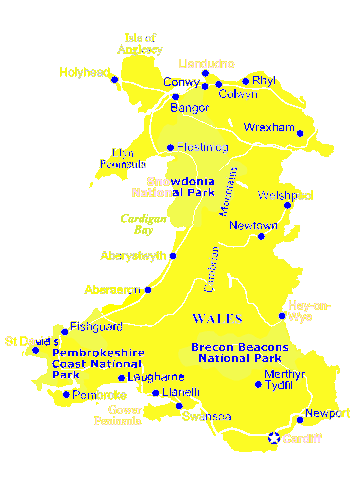
Wales is a
Principality within the United Kingdom and has an eastern
border with
England. The land area is just over 8,000 square miles.
Snowdon in North
Wales is the highest mountain at 3,650 feet.
The coastline is
almost 750 miles long. The population of Wales
as at the 2001 census is 2,946,200.
________________

Bangor Conwy
& Swansea Lodges are members
of the Welsh
Regional Association (Formed 1993).
Theosophy Cardiff
separated from the Welsh Regional
Association in
March 2008 and became an independent
body within the Theosophical Movement in March 2010
High Drama & Worldwide Confusion
as Theosophy Cardiff Separates from the
Welsh Regional Association (formed 1993)
Theosophy Cardiff cancels its Affiliation
to the Adyar Based Theosophical Society
Nature is infinite in space and time -- boundless and eternal,
unfathomable and ineffable. The all-pervading essence of infinite nature can be
called space, consciousness, life, substance, force, energy, divinity -- all of
which are fundamentally one.
2) The finite and the infinite
Nature is a unity in diversity, one in essence, manifold in form. The
infinite whole is composed of an infinite number of finite wholes -- the
relatively stable and autonomous things (natural systems or artefacts) that we
observe around us. Every natural system is not only a conscious, living,
substantial entity, but is consciousness-life-substance, of a particular range
of density and form. Infinite nature is an abstraction, not an entity; it
therefore does not act or change and has no attributes. The finite, concrete
systems of which it is composed, on the other hand, move and change, act and
interact, and possess attributes. They are composite, inhomogeneous, and
ultimately transient.
3) Vibration/worlds within worlds
The one essence manifests not only in infinitely varied forms, and on
infinitely varied scales, but also in infinitely varying degrees of
spirituality and substantiality, comprising an infinite spectrum of vibration
or density. There is therefore an endless series of interpenetrating,
interacting worlds within worlds, systems within systems.
The energy-substances of higher planes or subplanes (a plane being a
particular range of vibration) are relatively more homogeneous and less
differentiated than those of lower planes or subplanes.
Just as boundless space is comprised of endless finite units of space,
so eternal duration is comprised of endless finite units of time. Space is the
infinite totality of worlds within worlds, but appears predominantly empty
because only a tiny fraction of the energy-substances composing it are
perceptible and tangible to an entity at any particular moment. Time is a
concept we use to quantify the rate at which events occur; it is a function of
change and motion, and presupposes a succession of cause and effect.
Every entity is extended in space and changes 'in time'.
All change (of position, substance, or form) is the result of causes;
there is no such thing as absolute chance. Nothing can happen for no reason at
all for nothing exists in isolation; everything is part of an intricate web of
causal interconnections and interactions. The keynote of nature is harmony:
every action is automatically followed by an equal and opposite reaction, which
sooner or later rebounds upon the originator of the initial act. Thus, all our
thoughts and deeds will eventually bring us 'fortune' or 'misfortune' according
to the degree to which they were harmonious or disharmonious. In the long term,
perfect justice prevails in nature.
Because nature is fundamentally one, and the same basic habits and
structural, geometric, and evolutionary principles apply throughout, there are
correspondences between microcosm and macrocosm. The principle of analogy -- as
above, so below -- is a vital tool in our efforts to understand reality.
All finite systems and their attributes are relative. For any entity,
energy-substances vibrating within the same range of frequencies as its outer
body are 'physical' matter, and finer grades of substance are what we call
energy, force, thought, desire, mind, spirit, consciousness, but these are just
as material to entities on the corresponding planes as our physical world is to
us. Distance and time units are also relative: an atom is a solar system on its
own scale, reembodying perhaps millions of times in what for us is one second,
and our whole galaxy may be a molecule in some supercosmic entity, for which a
million of our years is just a second. The range of scale is infinite:
matter-consciousness is both infinitely divisible and infinitely aggregative.
All natural systems consist of smaller systems and form part of larger
systems. Hierarchies extend both 'horizontally' (on the same plane) and
'vertically' or inwardly (to higher and lower planes). On the horizontal level,
subatomic particles form atoms, which combine into molecules, which arrange
themselves into cells, which form tissues and organs, which form part of
organisms, which form part of ecosystems, which form part of planets, solar
systems, galaxies, etc. The constitution of worlds and of the organisms that
inhabit them form 'vertical' hierarchies, and can be divided into several
interpenetrating layers or elements, from physical-astral to psychomental to
spiritual-divine, each of which can be further divided.
The human constitution can be divided up in several different ways: e.g.
into a trinity of body, soul, and spirit; or into 7 'principles' -- a lower
quaternary consisting of physical body, astral model-body, life-energy, and
lower thoughts and desires, and an upper triad consisting of higher mind
(reincarnating ego), spiritual intuition, and inner god. A planet or star can
be regarded as a 'chain' of 12 globes, existing on 7 planes, each globe
comprising several subplanes.
The highest part of every multilevelled organism or hierarchy is its
spiritual summit or 'absolute', meaning a collective entity or 'deity' which is
relatively perfected in relation to the hierarchy in question. But the most
'spiritual' pole of one hierarchy is the most 'material' pole of the next,
superior hierarchy, just as the lowest pole of one hierarchy is the highest
pole of the one below.
Each level of a hierarchical system exercises a formative and organizing
influence on the lower levels (through the patterns and prototypes stored up
from past cycles of activity), while the lower levels in turn react upon the
higher. A system is therefore formed and organized mainly from within outwards,
from the inner levels of its constitution, which are relatively more enduring
and developed than the outer levels. This inner guidance is sometimes active
and selfconscious, as in our acts of free will (constrained, however, by karmic
tendencies from the past), and sometimes it is automatic and passive, giving
rise to our own automatic bodily functions and habitual and instinctual
behavior, and to the orderly, lawlike operations of nature in general. The
'laws' of nature are therefore the habits of the various grades of conscious
entities that compose reality, ranging from higher intelligences (collectively forming the universal mind) to
elemental nature-forces.
10) Consciousness and its vehicles
The core of every entity -- whether atom, human, planet, or star -- is a
monad, a unit of consciousness-life-substance, which acts through a series of
more material vehicles or bodies. The monad or self in which the consciousness
of a particular organism is focused is animated by higher monads and expresses
itself through a series of lesser monads, each of which is the nucleus of one
of the lower vehicles of the entity in question. The following monads can be
distinguished: the divine or galactic monad, the spiritual or solar monad, the
higher human or planetary-chain monad, the lower human or globe monad, and the
animal, vital-astral, and physical monads. At our present stage of evolution,
we are essentially the lower human monad, and our task is to raise our
consciousness from the animal-human to the spiritual-human level of it.
Evolution means the unfolding, the bringing into active manifestation,
of latent powers and faculties 'involved' in a previous cycle of evolution. It
is the building of ever fitter vehicles for the expression of the mental and
spiritual powers of the monad. The more sophisticated the lower vehicles of an
entity, the greater their ability to express the powers locked up in the higher
levels of its constitution. Thus all things are alive and conscious, but the
degree of manifest life and consciousness is extremely varied.
Evolution results from the interplay of inner impulses and environmental
stimuli. Ever building on and modifying the patterns of the past, nature is
infinitely creative.
12) Cyclic evolution/re-embodiment
Cyclic evolution is a fundamental habit of nature. A period of
evolutionary activity is followed by a period of rest. All natural systems
evolve through re-embodiment. Entities are born from a seed or nucleus
remaining from the previous evolutionary cycle of the monad, develop to
maturity, grow old, and pass away, only to re-embody in a new form after a
period of rest. Each new embodiment is the product of past karma and present
choices.
Nothing comes from nothing: matter and energy can be neither created nor
destroyed, but only transformed. Everything evolves from preexisting material.
The growth of the body of an organism is initiated on inner planes, and
involves the transformation of higher energy-substances into lower, more
material ones, together with the attraction of matter from the environment.
When an organism has exhausted the store of vital energy with which it
is born, the coordinating force of the indwelling monad is withdrawn, and the
organism 'dies', i.e. falls apart as a unit, and its constituent components go
their separate ways. The lower vehicles decompose on their respective
subplanes, while, in the case of humans, the reincarnating ego enters a
dreamlike state of rest and assimilates the experiences of the previous
incarnation. When the time comes for the next embodiment, the reincarnating ego
clothes itself in many of the same atoms of different grades that it had used
previously, bearing the appropriate karmic impress. The same basic processes of
birth, death, and
rebirth apply to all entities, from atoms to humans to stars.
14) Evolution and involution of worlds
Worlds or spheres, such as planets and stars, are composed of, and
provide the field for the evolution of, 10 kingdoms -- 3 elemental kingdoms,
mineral, plant, animal, and human kingdoms, and 3 spiritual kingdoms. The
impulse for a new manifestation of a world issues from its spiritual summit or
hierarch, from which emanate a series of steadily denser globes or planes; the
One expands into the many. During the first half of the evolutionary cycle (the
arc of descent) the energy-substances of each plane materialize or condense,
while during the second half (the arc of ascent) the trend is towards
dematerialization or etherealization, as globes and entities are reabsorbed
into the spiritual hierarch for a period of nirvanic rest. The descending arc
is characterized by the evolution of matter and involution of spirit, while the
ascending arc is characterized by the evolution of spirit and involution of
matter.
In each grand cycle of evolution, comprising many planetary embodiments,
a monad begins as an unselfconsciousness god-spark, embodies in every kingdom
of nature for the purpose of gaining experience and unfolding its inherent
faculties, and ends the cycle as a self conscious god. Elementals ('baby
monads') have no free choice, but automatically act in harmony with one another
and the rest of nature. In each successive kingdom differentiation and
individuality increase, and reach their peak in the human kingdom with the
attainment of selfconsciousness and a large measure of free will.
In the human kingdom in particular, self-directed evolution comes into
its own. There is no superior power granting privileges or handing out favours;
we evolve according to our karmic merits and demerits. As we progress through
the spiritual kingdoms we become increasingly at one again with nature, and
willingly 'sacrifice' our circumscribed selfconscious freedoms (especially the
freedom to 'do our own thing') in order to work in peace and harmony with the
greater whole of which we form an integral part. The highest gods of one
hierarchy or world-system begin as elementals in the next. The matter of any
plane is composed of aggregated, crystallized monads in their nirvanic sleep,
and the spiritual and divine entities embodied as planets and stars are the
electrons and atomic nuclei -- the material building blocks -- of worlds on
even larger scales. Evolution is without beginning and without end, an endless
adventure through the fields of infinitude, in which there are always new
worlds of experience in which to become selfconscious masters of life.
There is no absolute separateness in nature. All things are made of the
same essence, have the same spiritual-divine potential, and are interlinked by
magnetic ties of sympathy. It is impossible to realize our full potential,
unless we recognize the spiritual unity of all living beings and make universal
brotherhood the keynote of our lives.
Hey Look!
Theosophy in Cardiff
#theosophy_headquarters
#theosophical events #theosophy_cardiff
#theosophy_wales #national_wales_theosophy
#blavatsky #olcott #judge #secret_doctrine
#isis_unveiled